
How do people remember, believe, decide, and act—and what does that mean for the way we communicate?
In this PSG Consulting Conversation, Page Gardner is joined by Dr. Jiggy Geronimo, Kate Catherall and Dr. Drew Westen, to explore the research behind emotions-first communication and why rational, poll-tested messages can fall short when they fail to create emotional resonance.

More than 9 million voters nationwide are identified as disaffected with both major political parties, creating a growing challenge for traditional approaches to voter targeting and persuasion. The 2026 Double Negative Model, developed by New River Strategies, Patinkin Research Strategies, and Innovating for the Public Good, offers a new way to identify these voters at the individual level.

Misinformation and disinformation are increasingly shaping how people understand the world around them.
Page was joined this month by Mary Coller Albert, Tim Chambers and Roberta Braga to discuss the latest findings and practical lessons for campaigns, advocacy organizations, news organizations, and pro-democracy institutions.

New research shows that when voters are confronted with divisive “us vs. them” messages, changing the subject may be the wrong response.
In this conversation, Page Gardner is joined by Corrie Hunt of Hart Research, Adrienne Kimmell of the Transgender Freedom Alliance, and Anastasia Scourtes of Global Strategy Group to examine what actually works to counter these attacks—from addressing the broader politics of division to new battleground research on anti-trans messaging.

In this PSG Consulting Conversation, we heard from Daniel Squadron, author of The Fourth Branch, to explore one of the most consequential—and often overlooked—forces shaping American democracy: state legislatures.
While national elections dominate public attention, critical decisions affecting voting rights, reproductive freedom, education, representation, and governance are increasingly being made in state capitals.

If we are to revitalize our country, it is essential to understand how the Right achieved its goal of changing the operating environment in which elections are held and public policies debated.
One of their most effective strategies has been to pit groups of Americans against each other. “Othering,” as it’s known in research and policy circles, is increasingly recognized as a keystone to success by those who believe America’s democracy is not in their best interest.

Our realities are increasingly shaped by what we are “learning” from AI-based sources like ChatGPT, Claude, and Gemini. LLMs (AI Large Language Models) have become part of everyday life and increasingly shape what information people encounter and in what order, subtly deciding what's important and even what is true, sometimes without users realizing it. The key question is: How are these models trained? Who and what is training the trainers?

We hear all the time that America is deeply divided. But on many of the issues that affect people’s everyday lives, most Americans actually agree.
As screenwriter and political strategist Billy Ray points out, there’s broad support for core Democratic ideals, like raising the minimum wage, taking on climate change, investing in infrastructure and standing up to Big Pharma.

During our narrative series this year, one thing that became increasingly clear was that we will not be able to rebuild America unless we have a narrative of compelling stories, based in fundamental American values, that speak to everyday lives and signal a willingness to actually listen to one another with a desire to find common ground.
Our panelists Erica Williams Simon, Andy Bernstein and Nancy Zdunkewicz discussed the narratives and stories we should be promoting in 2026.
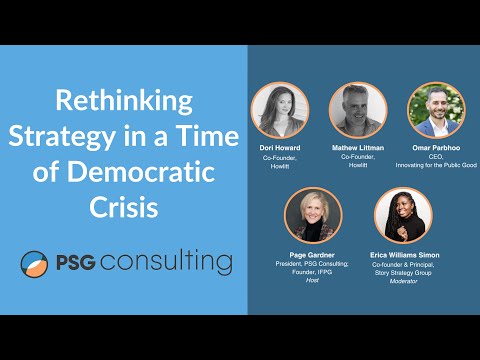
How did we get to a place where we have to march in the streets to protest a President that thinks he is a King with his Republican courtiers in the Congress obeying his every edict—lawful or not?
Panel Three of the Art of Narratives series included a truly fascinating presentation by Omar Parbhoo, outlining the work of Innovating for the Public Good (IFPG) to achieve foundational change through a cultural lens. We were also joined by Mathew Littman and Dori Howard of the leading firm Howlitt.

Othering has been one of the most effective tools used by those who would weaken our constitutional democracy to gain power.
This webinar spotlighted new research on how to begin to counteract othering in political discourse. We were joined by experts from Hart Research: Geoff Garin, Corrie Hunt and London Wagner.

We are facing unprecedented challenges to our constitutional democracy and the destruction of America's global alliances and standing. PSG Consulting and Innovating for the Public Good: R&D for Democracy (IFPG) have launched a First Mondays Webinar series to address these challenges.
Part three of this series was, “How Entertainment Media Can Help Reclaim Democracy.”

We are facing unprecedented challenges to our constitutional democracy and the destruction of America's global alliances and standing. PSG Consulting and Innovating for the Public Good: R&D for Democracy (IFPG) have launched a First Mondays Webinar series to address these challenges.
Part two of this series is, “Words as Weapons, Words as Bridges: Reclaiming the Debate.”

We are facing unprecedented challenges to our constitutional democracy and the destruction of America's global alliances and standing. PSG Consulting and Innovating for the Public Good: R&D for Democracy (IFPG) have launched a First Mondays Webinar series to address these challenges.
Part one of this series is, “A Better Story: Why We Need Narratives to Save Democracy (and Us).”

Innovating for the Public Good: R&D for Democracy’s (IFPG) goal is to restore America’s promise by taking a different approach — one that harnesses innovation to strengthen our democratic institutions, brings together multidisciplinary subject matter experts and applies a private sector research and development (R&D) model to experiment, refine, scale and measure the efficacy of successful efforts.
We have a strategic plan to accomplish these goals, and we are ready to implement.

During November’s First Mondays Webinar, the findings from research by PSG Consulting, TargetSmart and Hart Research were released for the first time.
The question at the center of this research was:
What do voters experience or process during the last months of the presidential campaign when they are being inundated with ads not only from presidential candidates but all candidates on the ballot?

Our final panel of the month — featuring David Broockman, Matt Lackey and Maeve Ward — offered strategic guidance on one of the toughest tasks in any election: targeting the holdouts, undecideds and conflicted, and persuading them to vote for a particular candidate or whether or not to vote at all.

This week, we heard from Gretchen Barton, Founder and Principal at Worthy Strategy Group, LLC; Henry Fernandez, CEO at Fernandez Advisors; and Ben Lazarus, Director of Research Solutions at TargetSmart on the impact of the September 10 presidential debate on key voting segments.

In the second webinar of PSG Consulting's First Mondays September series, our distinguished panelists went in depth on the structural forces and dynamics determining the composition of the 2024 electorate.

The first webinar in our critical four-part First Mondays September Series took place on September 9, where we explored the forces shaping the American electorate, with a focus on the challenges that extend beyond the 2024 elections.

The 2020 elections saw enormous changes in how campaigns were conducted and how people voted. This is the first presidential election after the height of COVID-19. Will this be an election in which — as someone has said before — the more things change, the more they stay the same?

Artificial Intelligence is in its infancy in terms of changing the workplace and workforce, education and learning, and the structure of economic systems. The impact of AI on elections has the potential for immense implications.
What are the tools we can use in 2024, and how do we address them in the future?

Women have been equal partners in the success of this country’s advancements and achievements. They aren't always recognized, but surely, without their contributions, our country would be less advanced, less prosperous and less respected in the world.
Women’s power to author their own lives is centered on voting — refusing to let politicians determine their future is fundamental.

A substantial segment of the electorate has not been identified, modeled, or targeted precisely with nuanced communications. They do not like President Biden or Donald Trump, and some won't vote for either, leading to a substantial third-party vote. These voters are “Double Negatives.”
But, for the first time, we have a way to target these voters. This is a real breakthrough. Ultimately, this could be a game changer in determining the outcome of the election.

$18 billion dollars will be spent in the 2024 elections by candidates and advocacy organizations. Good news for some, but how can we judge if it is worth it? This month, we heard from admired strategist, Hal Malchow, about how current spending decisions may be improved and diversified. Hal’s new book, Reinventing Political Advertising, explores new ways to think about television advertising in this election cycle and beyond.

Donald Trump's supporters have produced a video saying he was sent by GOD to rescue America from the "heathens" (very broadly defined). This storyline is not just about Donald Trump, though. It is about the MAGA worldview — and it provides a basis for activities that both weaken democracy; targets whole classes of people; and justifies violence for the greater good.
Where do we go from here? How can a deeper understanding of these tactics strengthen our position in this crucial election year?

Othering or the “us against them at all costs” rhetorical campaigns waged through identity politics and culture wars is central to right-wing MAGA adherents and their path to power. Dehumanization and creating perceived enemies through racial and other identities is a main theme of Donald Trump's campaign messaging.
How powerful is this type of messaging? With what audiences? And how can it be addressed and countered?

Qualitative and quantitative polling one year out is not about the horse-race numbers per se. Rather, these polls give us a window into some of the underlying trends and dynamics. This research, consisting of web dials of videos of Presidential candidates in various settings; focus groups among Republican factions; and the large battleground survey, is the most comprehensive look at the forces that will shape 2024 as we know them today.

What are the factors impacting elections in a presidential year that receive less focus? What are the common assumptions that should be questioned? Are there new paradigms worth considering?

The ability to understand our past — the good, bad, and truly ugly — and engage in meaningful, sometimes difficult, conversations provides a pathway to create a better future.
How are we to see the humanity in those who we consider different? How do we address our history in ways that do not further divide, but rather, create a shared vision of a better future?

Communications to advance progressive values take many forms. The power of art as a form of political communication has not been explored adequately thus far. What can art tell us about our culture, about how to effect change, and how to move the narrative discreetly but powerfully?

The 2022 elections surprised many, confounded some, and confirmed findings for others. And, a rare few thought the Democrats missed opportunities to win more. With an in-depth analysis of the election using some unique tools, Catalist staff have looked at voting patterns and trends across the country. The question that most focuses our attention is this: What do the 2022 Midterms portend, will the trends seen in the mid-term continue in 2024?

How do voters understand the extent to which public policies impact their lives? When does the realization hit? Elected officials often run on their public policy records—our next speaker argues…that is not the right approach.
This session, we'll take a deep-dive into how to close the turnout gap between high- and low-propensity voters in the Black community.

As we look at state legislative actions in advance of the 2024 elections, what do we see? For better or worse, the real laboratories of democracy (and autocratic behavior) are in the states. Knowing the state playbook of those who would undercut rights and turn back the clock is crucial to developing strategies to confront them.

This month's session continued to focus on key voter segments and issues that will be increasingly important to the outcome of the 2024 elections—from the top of the ticket to down ballot races. This included discussions of the potential enthusiasm gap for the ticket, representation of the increasingly diverse electorate, and the impacts of new voter laws and the changing life circumstances of voters.

As we think about the 2024 elections and the voters who will comprise the electorate, what can we glean from past cycles?

Watch our inaugural First Monday webinar of 2023, as we examine what 2022 tells us about the nature of our democracy—regarding both its strengths and potentially precarious state.
This month, we began a series of presentations and discussions with top research analysts as they discussed their work in general election surveys—as well as the Georgia runoff.
The dust has begun to settle on the 2022 Midterm Elections, and it’s time to begin a discussion about the way ahead.
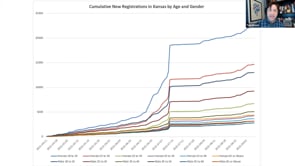
This month’s webinar brings together two respected experts who have the most in-depth view of 2022—from the voter’s perspective. Who is registering, and what do past turn out patterns really tell us? How volatile is voter opinion as we approach Election Day, and what are the trends we are seeing – what are some of the constants from election to election and what is changing?
How can we begin to understand the dynamics that will impact elections in November of 2022, and where?
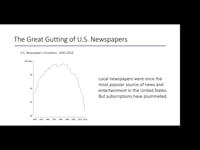
There are a number of factors influencing the availability and content of local news. Communities and their institutions are built or, sometimes, torn apart due to local news, or the lack thereof. Please join me to hear from those who know the dynamics impacting local news.
The principal partners in this project are Stanley Greenberg and DCorps as well as my firm, PSG Consulting. The web-dials give a graphic reaction of the State of the Union speech.
“You are not hearing me,” is another way of saying, you are not listening in a manner that will lead to understanding.
Gender, Race, Geography, Education, Marital Status, and Age are some of the ways in which we classify voters. What are some of the other ways in which we need to understand voters to reach them beyond some of the traditional demographic categories?
